
Deseret News
Saturday, July 3, 2010 — Last update: 1:17 a.m. MDT
Scientist promotes personal devices to monitor radiation levels By Amy Joi O’Donoghue
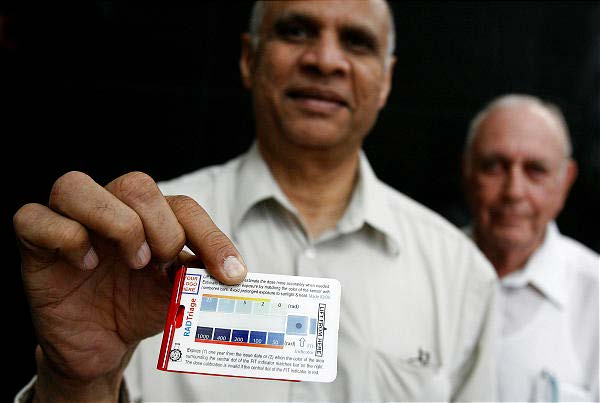
Gordhan Patel, founder of JP Laboratories, and Dr. Allen Brodsky display a RADTriage, a radiation dosimeter. Laura Seitz, Deseret News
SALT LAKE CITY — Too many people, including first responders like police and firefighters, have an irrational fear of exposure to even small doses of radiation — fear that one noted physicist says will lead to chaos in a nuclear or radiological attack.
Allen Brodsky, who was in town this week for a meeting of the Health Physics Society, said the public’s lack of understanding about radiation and a reluctance by policymakers to educate the nation leaves the country vulnerable. “More people will be injured or die in the panic of an attack than will die from radiation itself,” Brodsky said. “Even the ill-equipped first responders will scream and run away, and so what is the public going to do?”
Brodsky, an adjunct professor at Georgetown University and the society’s first chairman of the homeland security committee, stressed the need for first responders and even the public to have a personal dosimeter that monitors radiation exposure. Such knowledge, he argued, is essential to assess the degree of exposure, if evacuation is necessary and, alternately, if panic can be avoided because there are no long-term health risks.
Brodsky, 82, is well-acquainted with those risks, having been on ground zero of the nation’s first H-bomb test at Enewetak Atoll in 1952. After the test, code-named “Mike,” Brodsky — an Armyscientist at the time — drove a truck over the muddy beach to measure the results. The second
detonation — Operation Castle at Bikini Atoll in 1954 — also had Brodsky monitoring radiation levels. Such experiences, coupled with his academic career, have led Brodsky and others to push police officers, firefighters and the public in general to get a RADTriage, a self-indicating instant radiation alert dosimeter, or the smaller RADSticker, which uses radiosensitive ink.
After 9/11, the Department of Defense hired Gordhan Patel, founder of JP Laboratories, to develop the devices for use by the military and police. Patel said he sank $1 million of his own money into the products’ development, while another $3 million was funded by the government. Since then, the products have been distributed free to thousands of police officers or firefighters across the country. At least 18 police or fire agencies in Utah are using them, including South Salt Lake, Layton and the Davis County Sheriff’s Office, said Stephen Jones, who describes himself as a “social entrepreneur” trying to get the word out.
Jones was in Layton earlier this year and met with the city’s assistant manager, Jim Mason, who
oversees the city’s emergency response functions.“I tell them the long training takes 42 seconds and the short training takes 30 seconds,” explained Jones, who hands out a billfold-size piece of paper on steps to take in the event of radiation exposure. The training includes handing out the RADTriage, which is the size of a credit card, color-blind friendly and non-electronic, or the RADSticker, which is about the size of a postage stamp. Both have a sensor material that turns blue upon polymerization by radiation. They cost less than $10 but are available free via grants to emergency responders.
Jones, who belongs to Physicians for Civil Defense, said that organization makes them available
to emergency responders, as well. Mason said when he was approached about the products and the training, he was intrigued. “My feeling was ‘what do we have to lose?’ If you look at all the hazards that could potentially occur, it is something that we ought to be aware of,” he said. “While that hazard in Utah may be lower than others, my goal is to protect against all of them.”
More information on the personal dosimetry devices can be found at the government’s website,
www.tswg.gov, by searching “RADTriage.”
e-mail: amyjoi@desnews.com