SYNTHETIC BLOOD (RED CELL SUBSTITUTE)
There is a critical need for red blood cell (RBC) substitutes, or synthetic blood, due to the significant limitations of traditional donated blood supplies during emergencies, traumatic injuries, and mass-casualty events. A RBC substitute is a substance designed to transport and deliver oxygen when transfused in the blood circulatory system.
Many different approaches are made to find a substitute for a RBC in the past seven decades. They include (i) modified, crosslink or polymerized bovine or human hemoglobin, (ii) perfluorocarbon (perfluorodecalin and perfluoromethylcyclohexylpiperidine) emulsion, (iii) liposome-encapsulated RBC and (iv) stem-cell-derived RBC. No oxygen-carrying red blood cell substitute is currently approved by the US FDA.
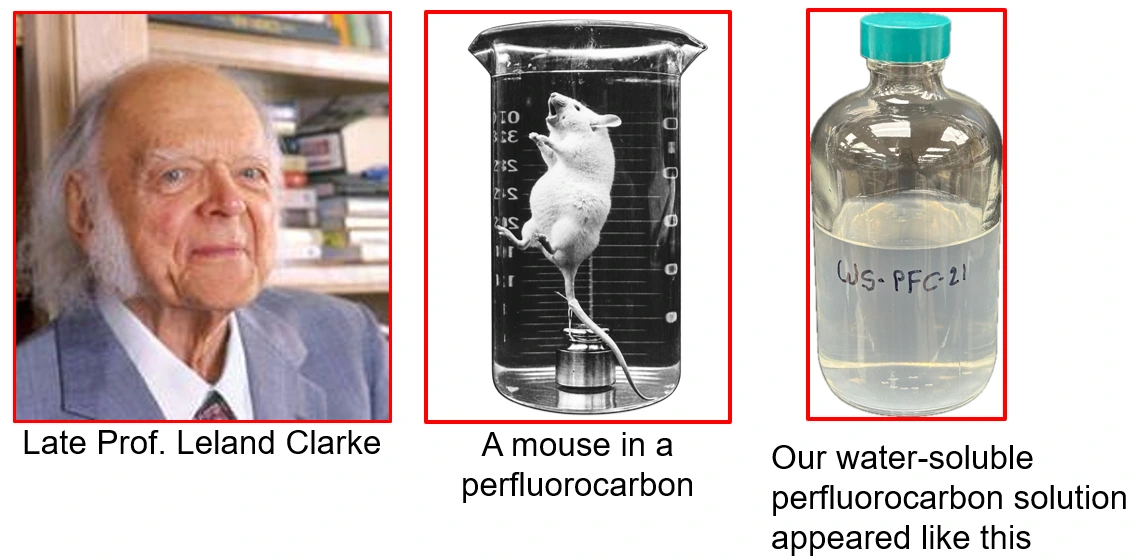
The late professor Leland Clarke of the University of Cincinnati, Ohio in 1980s and 1990s had demonstrated that perfluorocarbon can be used as a RBC substitute because 100 ml of perfluorocarbons dissolve 100 ml of oxygen and 200 ml of carbon dioxide. We proposed water-soluble perfluorocarbons to eliminate problems associated with water insoluble perfluorocarbons. We synthesized water-soluble fluorocarbons (CF3-(CF2)n-(CH2)2-WS, where WS is a water-soluble functionality). Their solutions dissolved sufficient oxygen to replace 50% of mice blood. The project was with over a million dollars grant from US Heart Lungs and Blood Institute, in early 1990s. After a few years of efforts, the project was discontinued as it required massive investment.